Colonialism isn’t over - it’s evolved
When we think of colonialism, we often imagine a distant past—European empires expanding across continents, claiming lands, and imposing their will. But what if colonialism never truly ended? What if its core structures and attitudes simply transformed, continuing to shape our world under a new name: coloniality?
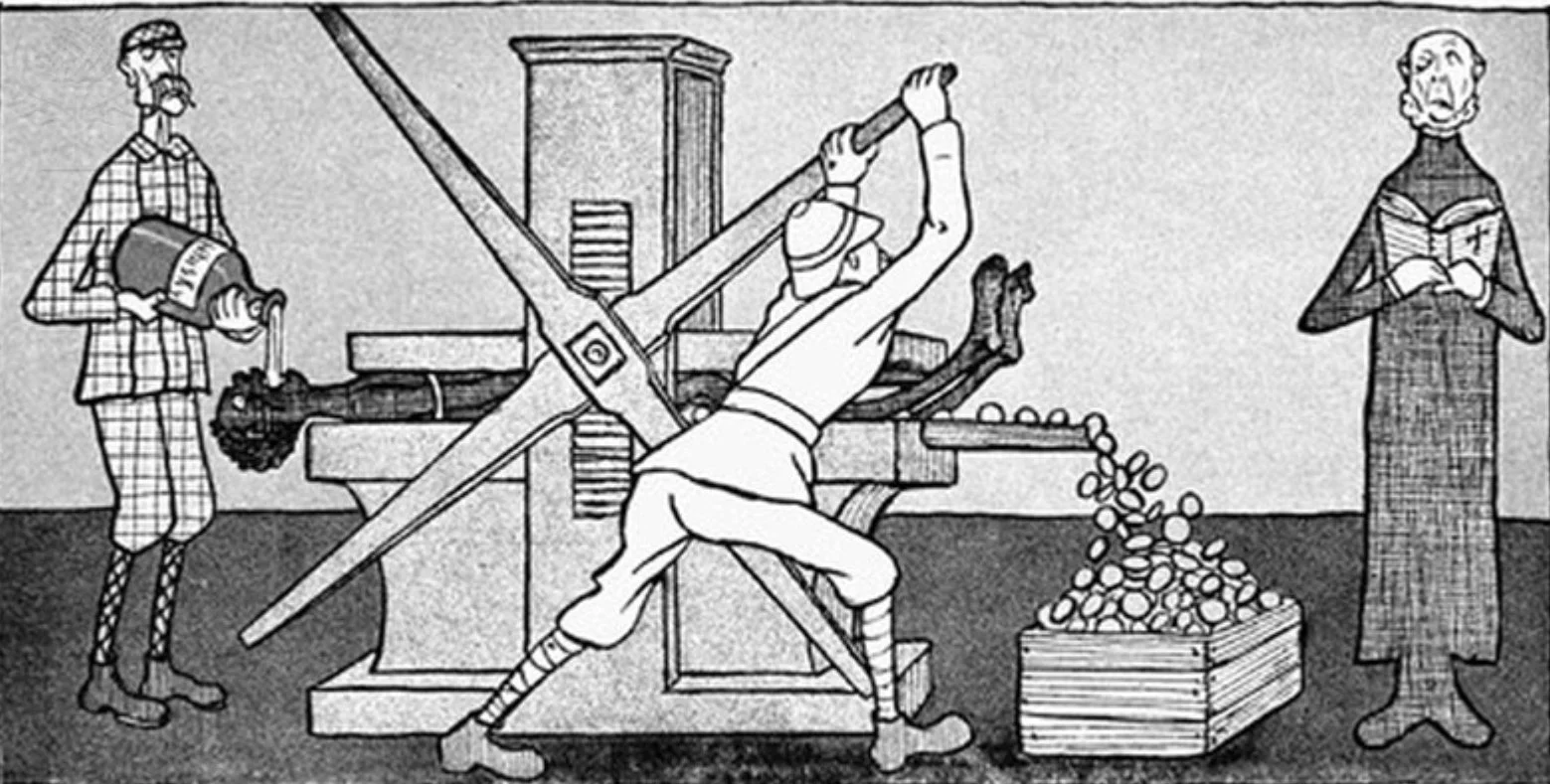
A black-and-white cartoon depicting colonial exploitation. A press squeezes a native person to extract money, while another pours a substance into their throat, symbolizing economic exploitation and social control.
Coloniality is a concept that refers to the long-standing patterns of power that emerged as a result of colonialism but continue to exist and influence labour, knowledge, culture, and identity long after direct colonial rule has ended.
This blog post explores how coloniality—rooted in the legacy of colonialism—continues to influence crime, harm, and the state, especially in the relationship between the Global North and Global South. Through real-world examples, we’ll see how power, resource extraction, and racial discourses still drive inequality and exploitation today.
From Colonialism to Coloniality: The Roots of Global Power
Coloniality isn’t a sudden event; it is the continuous evolution of power dynamics forged during the colonial and imperial eras, kick-started by the rise of globalisation in the late 15th century. This expanding interconnectedness of nations resulted in events in one part of the world having a greater impact elsewhere, underscoring the widening Global North/South disparities (Dimou, E. 2020, p. 63). The North and South refer not to geography, but to the divide between powerful and economically wealthy countries and those less powerful and economically wealthy countries (Dimou, E. 2020, pp. 190-191).
Colonialism was never just about land—it was about control. European powers expanded into Africa, Oceania, the Americas, and Asia, using force and violence to dominate societies (Dimou, E. 2020, p. 64). The motivations ranged from territorial expansion to a so-called “civilizing mission,”(Richard, D. 2018) justified by pseudoscientific theories like social Darwinism (Copson, L. 2020, pp. 190-191) and the eugenics movement (Copson, L. 2020, pp. 192-193). These ideas created a degrading discourse that saw white Western Europeans as superior and non-white bodies as irrational and underdeveloped (Dimou, E. P. 202) This fuelled racism, oppression, and the dehumanization of colonized peoples, paving the way for slavery and resource extraction.
Sugar, tobacco, and coffee became commodities exported from colonies to Europe, driving global capitalism and environmental destruction. For example, the success of shipping sugar to Europe paved the way for foreign capital to fund and shape the economic and political scene in the colonies (Ortiz, 1947, cited in Dimou, E. 2020, pp. 65-66).
Coloniality: The Four Axes of Power
Peruvian sociologist Anibal Quijano coined “coloniality” to describe the enduring power structures established during centuries of colonial rule (Dimou, E. 2020, p. 200). These structures persist today through four main axes:
Authority: Dominance in nation-states and institutions.
Economy: Control over resources, labour, and land.
Knowledge: Control over religion, science, philosophy, and epistemology.
Subjectivities: Shaping how individuals think, feel, and relate—including racism and sexism.
Coloniality isn’t just a relic—it actively justifies state criminality and harm in the present.
Case Study 1: Fossil Fuels and Ecocide in Puerto Rico
The first axes is authority. The Caribbean archipelago of Puerto Rico (PR) with its rich natural resources, has been under US dominion for over a century, establishing a political framework that entrenched a dependent relationship (Atiles and Rojas-Páez, 2022). Economic crises, natural disasters, and the COVID-19 pandemic have left the island vulnerable.
Enter the Applied Energy System (AES) coal-fired plant. Promised as a source of jobs, it instead brought environmental devastation.
· The harms: the plant produces over 300 million tons of toxic coal ash waste per year, which is dumped near communities. The waste contains heavy metals and radioactivity. Exposure has been linked to pulmonary diseases, cancer, birth defects, and fatalities among residents and workers (Atiles and Rojas-Páez, 2022).
· The corporate-state agreement: after protests, the PR government enacted Act 40 (2017). This legislation, heavily lobbied for by the AES, did not prohibit the disposal of coal ash. Instead, it established a legal framework for AES to continue its ash dumping (Atiles and Rojas-Páez, 2022).
· The outcome: this case demonstrates Fossil Imperialism (Jurema and König, 2025) and Ecocide (European Commission, no date). The continued legislative support for ash dumping by the PR government provides AES with legal discretion to continue intentionally harmful operations (Atiles and Rojas-Páez, 2022). As author Llorens argues (cited in Atiles and Rojas-Páez, 2022), Jobos Bay of PR is a Sacrifice Zone where dominant actors rationalize their practice without consideration for historically marginalized communities.
The harms inflicted, driven by corporate-state agreements, have fundamentally constituted the axes of coloniality of authority.
Case Study 2: Tobacco Production and Dependency in Malawi
The second axes of coloniality is the economy. Malawi is the world’s leading tobacco producer, yet remains one of its poorest countries. This paradox highlights how colonial economic structures create a debilitating dependency theory dynamic (Richard, 2018).
· Corporate control: two global corporations control the industry (Kulik, et al., 2017). When the former president proposed tobacco price floors, international companies refused to buy until the floors were removed, forcing the government to comply (Kulik, et al., 2017). This demonstrates the power imbalance where global corporations dictate economic policy.
· The debt cycle: tenant farmers are often given loans for supplies and food. Post-harvest, sales are often insufficient to cover the loan, trapping many in a cycle of debt, which is reflected in low educational outcomes (Kulik, et al., 2017).
· Human cost: an estimated 80,000 children work on tobacco farms, absorbing the equivalent of fifty cigarettes of nicotine per day. This saved the industry about 10.7 million U.S. dollars annually through unpaid child labour between 2000-2010. Deforestation and pesticide use also constitute environmental damage (Ecocide) (Kulik, et al., 2017).
In alignment with Richard’s (2018) dependency theory, the case of Malawi reinforces the notion that powerful Global North corporations impede development in post-colonial countries by creating a continual dependency, directly addressing the second axes of coloniality: the economy.
This dependency isn’t accidental—it’s a legacy of colonial power structures. These relationships keep the Global South vulnerable and underdeveloped, reinforcing a system where profit comes before people.
Case Study 3: Racial Discourses and Media Representation
The control of knowledge and subjectivities, largely maintained through media narratives (Martin, 2021) represent the concluding two axes of coloniality. The relocation of manufacturing to the Global South has created a global economic relationship where the North holds capital and the South provides cheap labour (Martin, 2021).
· The distortion: global supply chains are controlled by transnational corporations (TNCs) with the primary objective of minimizing labour expenses. However, Western news coverage often ignores this structural issue, instead blaming poor working conditions on internal problems like corruption, violence, and instability in the Global South (Martin, 2021).
· The stereotype reinforcement: Global South counties are often under-represented in Northern news, receiving attention primarily for negative, stereotypical themes likes wars, tragedies, and suffering. This selective focus ideologically conceals the accountability of global economic forces, reinforcing colonial stereotypes that populations in the Global South are uncivilised, irrational, corrupt, and deviant (Martin, 2021).
These discourses and ‘othering’ reinforce the historical colonial mind-set where populations in the Global South are seen as uncivilized and less worthy, shaping the knowledge and subjectivities of populations in the Global South.
Conclusion: Coloniality Lives On
Colonialism may be officially over, but its logic and power structures persist as coloniality. Through the economy, knowledge, subjectivities, and authority, coloniality continues to justify harm and exploitation. Whether it’s environmental destruction in Puerto Rico, economic dependency in Malawi, or racial discourses in the media, the shadows of colonialism still shape our world today.
Ultimately, the axes of coloniality are sustained by silence. The exploitation in Malawi and the ecocide in Puerto Rico are not lawless acts; they are entirely legal, sanctioned by corporate-state agreements. For the legal community, the path forward requires more than just awareness; it requires an active disruption of the status quo. Law schools must become spaces where the link between global corporate dominance and colonial history is exposed. As future practitioners, we must challenge the narratives that normalise this dependency, ensuring that the law serves as a shield for the vulnerable, not a sword for the powerful.
References:
Atiles, J. and Rojas-Páez, G. (2022) ‘Coal Criminals: Crimes of the Powerful, Extractivism and Historical Harm in the Global South’, British journal of criminology, 62(5), pp. 1289–1304.
Copson, L (2020) ‘Redrawing borders: crime, harm and the state’, in Copson, L., Dimou, E. and Tombs, S. (eds) Crime, harm and the state, book 2. Milton Keynes: The Open University, pp. 179–210.
Dimou, E. (2020) ‘Consuming drugs’, in Copson, L., Dimou, E. and Tombs, S. (eds) Crime, harm and the state, book 1. Milton Keynes: The Open University, pp. 47–76.
Dimou, E. (2020) ‘Where’s the harm in tourism?’, in Copson, L., Dimou, E. and Tombs, S. (eds) Crime, harm and the state, book 1. Milton Keynes: The Open University, pp. 181–214.
European Commission (no date) Environmental Crime Directive.
Jurema, B., König, E. and Sultana, F. (2025) ‘State Power and Capital in the Climate Crisis: A Theory of Fossil Imperialism’, in Confronting Climate Coloniality. 1st edn. Routledge, pp. 62–77.
Kulik, M.C. et al. (2017) ‘Tobacco growing and the sustainable development goals, Malawi’, Bulletin of the World Health Organization, 95(5), pp. 362–367.
Martin, V.C.S. (2021) ‘Dismissing class: Media representations of workers’ conditions in the Global South’, Nordicom review, 42(S3), pp. 35–55.
Richard, G. (2018) ‘On colonialism and development – why the underdevelopment of the South cannot be delinked from the experience of the past’, African Journal of Governance & Development, 7(1), pp. 6–16.
'This is how the Englishman colonizes.' Cartoon by Thomas Theodor Heine in the German satirical publication 'Simplicissimus,' 1904., Fine Art, Encyclopædia Britannica Image Quest.