The all-seeing eye: Bentham's panopticon and the architecture of modern control
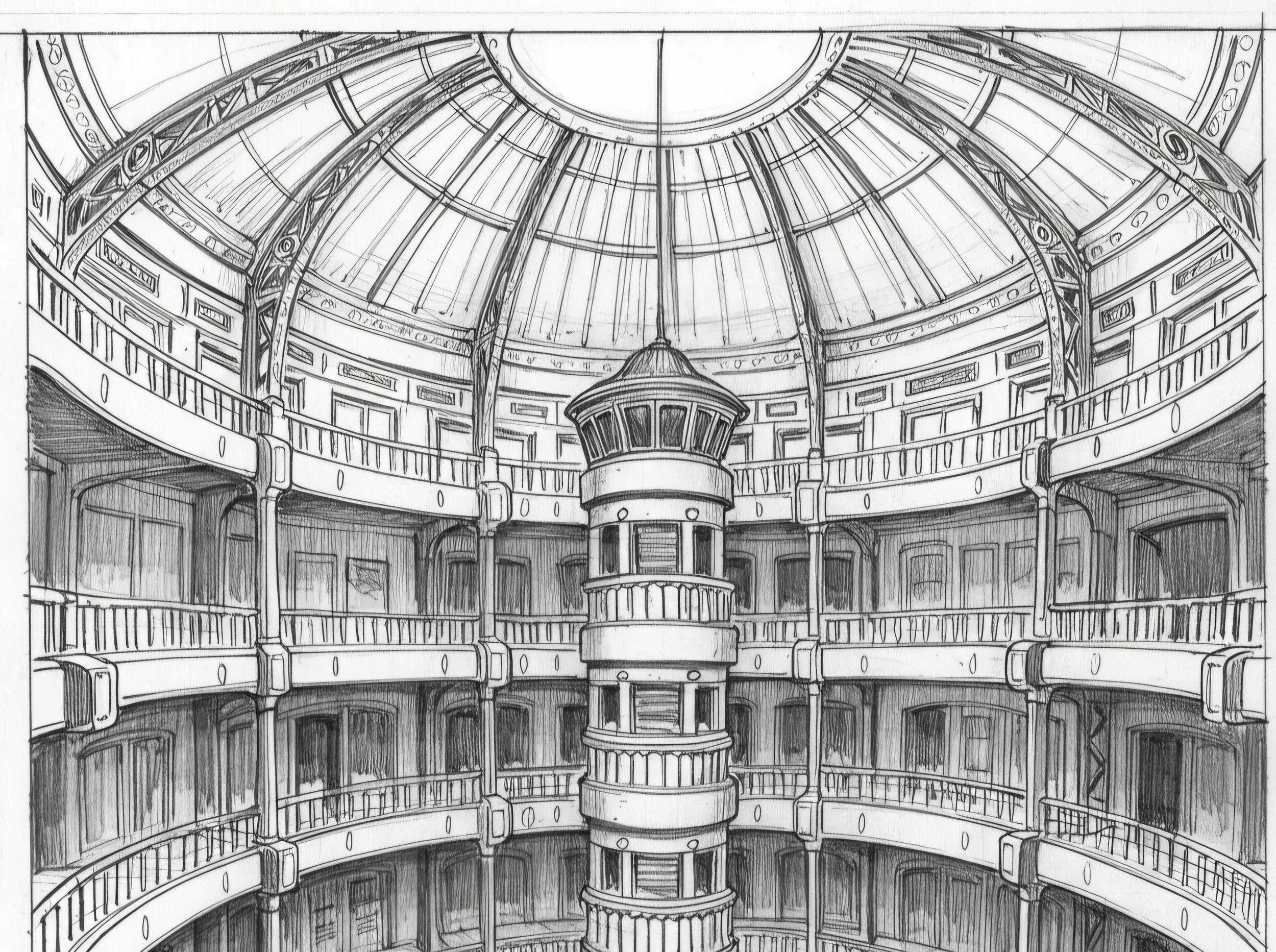
Sketch of a fictitious prison using the panoptic mode of control. Alexandra Strohbehn
From eighteenth-century prison design to algorithmic governance, surveillance has never been more total, or more invisible.
In 1791, the English philosopher and legal reformer Jeremy Bentham published a deceptively simple architectural proposition: a circular prison in which a single unseen watchman could observe every inmate at all times. He called it the Panopticon. From the Greek panoptes, "all-seeing", and declared it "a new mode of obtaining power of mind over mind" (Bentham, 1791, p. 31). More than two centuries later, this blueprint remains one of the most generative concepts in the criminological and sociological imagination.
Bentham's design was elegantly brutal. Inmates were housed in individual cells arranged in a ring around a central inspection tower. Backlighting ensured that each prisoner was permanently visible from the tower, while the tower's venetian blinds ensured that guards could never be seen. The genius, and horror, of the design lay in its economy: you need not actually watch every prisoner, so long as every prisoner believes they might be watched at any moment (Bentham, 1791). Surveillance, Bentham understood, is most powerful when it is uncertain.
"He who is subjected to a field of visibility, and who knows it, assumes responsibility for the constraints of power; he makes them play spontaneously upon himself."
— Foucault, M. (1975).
Discipline and Punish, p. 202–203.
Foucault and the disciplinary society
Bentham's Panopticon might have remained a curiosity of prison reform literature were it not for Michel Foucault's landmark reinterpretation in Discipline and Punish (1977). For Foucault, the Panopticon was not merely an architectural blueprint but a diagram of modern power itself. He argued that from the eighteenth century onwards, disciplinary techniques such as the examination, the timetable, the normalising judgment, migrated outward from prisons into schools, hospitals, barracks, and factories (Foucault, 1975, p. 228). Society itself became, in his phrase, “carceral”.
The key mechanism, Foucault insisted, was internalisation. Under panoptic conditions, subjects begin to police themselves. The prisoner who cannot see whether the guard is watching must behave as though the guard is always watching. Power, then, need not be exercised continuously. It need only be felt as a permanent possibility (Foucault, 1975, p. 201). This is a profound criminological insight: the most effective social control is that which renders itself superfluous, because the controlled come to control themselves.
From stone walls to data streams
Contemporary scholars have extended Foucault's analysis far beyond the prison walls. David Lyon's concept of the "surveillance society" charts how the logic of the Panopticon has been radically amplified, and transformed, by digital technology (Lyon, 2001, p. 7). Where Bentham's tower was fixed and local, digital surveillance is fluid, global, and largely invisible. Closed-circuit cameras, biometric databases, social media monitoring, and algorithmic risk-scoring have created what Lyon calls a "surveillant assemblage". Not one gaze, but millions of intersecting ones (Haggerty and Ericson, 2000, p. 605).
Crucially, contemporary surveillance has shed the prison's punitive register entirely. As Shoshana Zuboff (2019) argues in her analysis of "surveillance capitalism," the dominant contemporary model is not disciplinary but extractive: tech corporations harvest behavioural data not to discipline individuals but to predict and modify their future conduct for commercial ends (Zuboff, 2019, p. 8). The watcher is no longer the state, and the watched are no longer criminals. They are consumers, citizens, commuters, students. Everyone.
Critiques and complications
Moreover, feminist and postcolonial scholars have argued that panopticism is not experienced uniformly. Surveillance falls disproportionately upon racialised, gendered, and marginalised communities (Browne, 2015, p. 16). The "neutral" gaze of algorithmic systems frequently encodes historical prejudices, producing what Eubanks (2018) terms "digital poorhouses", automated systems that surveil, judge, and punish the poor with mechanical efficiency. To speak of the panopticon without attending to these asymmetries is to mistake its architecture for its politics.
Conclusion
Bentham designed a prison. Foucault read in it the blueprint of modernity. Both were right, and neither was sufficient. The panopticon endures as a conceptual tool because it captures something genuinely durable about power: its preference for economy, its reliance on visibility, and its aspiration toward the self-regulating subject. But the proliferation of surveillance in the digital age demands that criminologists move beyond the single tower and the single gaze. Surveillance today is plural, participatory, commercial, and contested. Understanding it requires not just Foucault's archaeology of power, but also a politics of resistance, an acknowledgment that the watched can, and do, watch back.
References
Bentham, J. (1791) Panopticon; or, The Inspection-House. London: T. Payne.
Browne, S. (2015) Dark Matters: On the Surveillance of Blackness. Durham, NC: Duke University Press.
Eubanks, V. (2018) Automating Inequality: How High-Tech Tools Profile, Police, and Punish the Poor. New York: St. Martin's Press.
Foucault, M. (1977) Discipline and Punish: The Birth of the Prison. Translated by A. Sheridan. London: Allen Lane.
Haggerty, K.D. and Ericson, R.V. (2000) 'The surveillant assemblage', British Journal of Sociology, 51(4), pp. 605–622.
Lyon, D. (2001) Surveillance Society: Monitoring Everyday Life. Buckingham: Open University Press.
Mathiesen, T. (1997) 'The viewer society: Michel Foucault's "Panopticon" revisited', Theoretical Criminology, 1(2), pp. 215–234.
Zuboff, S. (2019) The Age of Surveillance Capitalism: The Fight for a Human Future at the New Frontier of Power. London: Profile Books.